
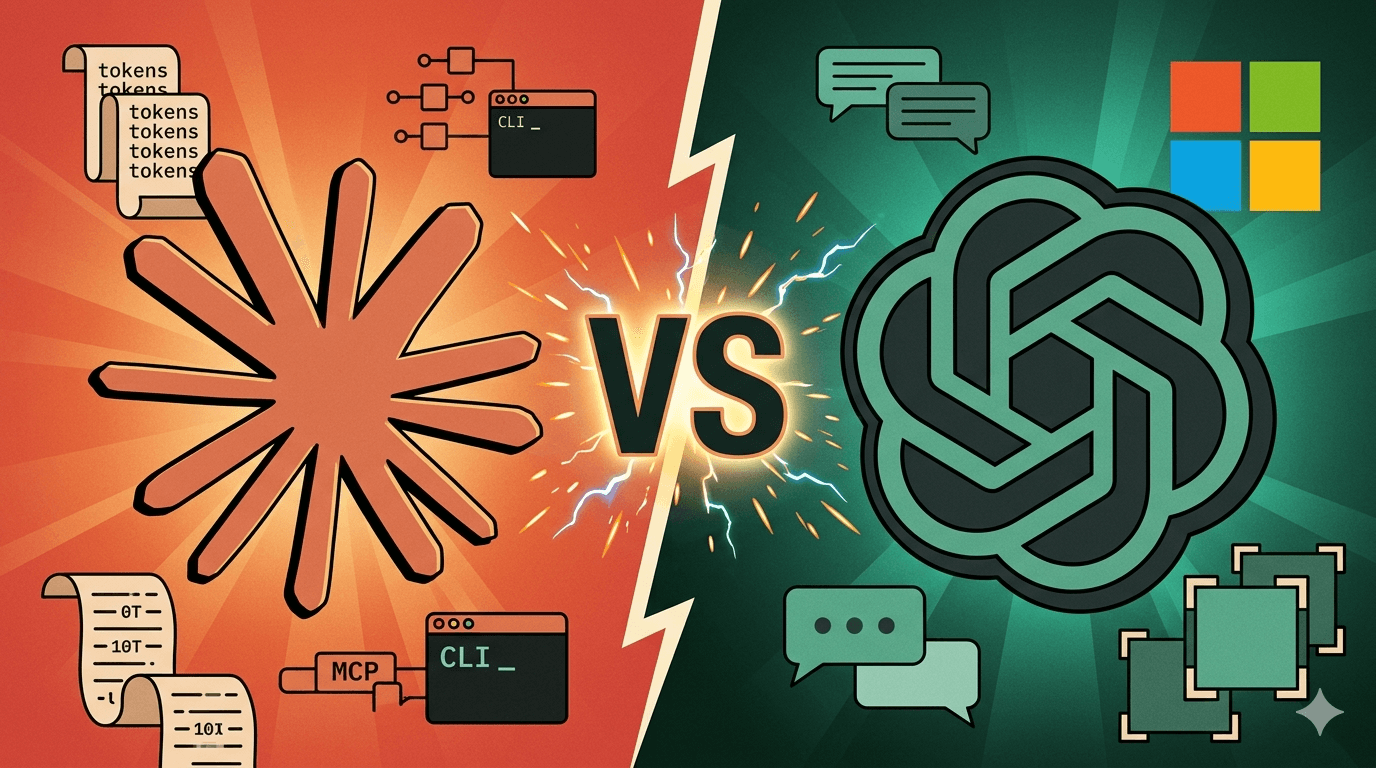
The CEO asks, in the middle of a leadership meeting: "so, Claude or GPT for our internal assistant?". IT has one camp. Marketing has another. The sales guy, who uses ChatGPT daily, doesn't even grasp that there could be more than one.
Three hours later, the decision is pushed to the next meeting.
I'm writing this because the question comes up every week in client work. And because 80% of the time, it's the wrong question.
"Claude vs GPT" isn't the right question by default
The reflex is to compare the two models like you'd compare two cars: performance, price, finish. You run a benchmark, line up a few prompts, pick whichever is fastest or cheapest.
It doesn't work because in a business setting, the model itself accounts for maybe 20% of the end result. The other 80% comes from the context you feed it, the tooling around it, and how it plugs into your existing stack.
The model doesn't make the solution. It's one part of the solution.
Which means the real comparison isn't "Claude vs GPT". It's "Claude stack vs GPT stack" for your specific case.
What actually separates them in 2026
I'll set aside raw performance benchmarks. On everyday tasks, both are good. The real difference sits elsewhere.
Useful context
Claude goes up to 1M tokens of context. In practice, that means you can feed it a full product documentation, two years of framework contracts, or an entire module's source code, and ask for a coherent synthesis without fragile chunking.
GPT caps lower on "reliable" production context. You can work around it with RAG (retrieval augmented generation). Everyone does. But each chunk you create introduces noise, complexity, and one more failure point.
For an internal assistant that has to answer while considering a dense corpus (legal, technical, medical), Claude has a structural edge.
The ecosystem for tech teams
Three things Claude built that OpenAI hasn't matched at the same level:
- Claude Code: a command-line tool for developers, with hooks, custom slash commands, MCP servers. Deployable across a team. Not a chatbot, an actual work tool.
- Agent SDK: a framework to build agents that hold up in production, with memory management, sub-agents, custom tools. The OpenAI equivalent exists, less polished.
- MCP (Model Context Protocol): an open standard protocol to connect Claude to any internal tool. OpenAI pushes its own proprietary format. MCP is already adopted by other players, which avoids vendor lock-in.
If your roadmap includes "build our own agents" or "connect AI to our business tools", the gap is significant.
Prompt caching and real cost
Claude ships native prompt caching. Concretely: when your assistant uses 50,000 tokens of fixed context on every request (your internal procedures, your templates), Anthropic bills you for those tokens once, not a thousand times.
On an assistant used 500 times a day, that cuts the API bill by three to four without changing a line of code. OpenAI caught up with its own cache, but the Claude integration remains cleaner and better documented.
Product positioning
GPT is the default consumer LLM. ChatGPT has massive distribution, native Microsoft 365 integration, an enterprise offer that IT can roll out without friction.
Claude sits more as "the model for developers and businesses that care about reasoning quality". Claude for Work exists but has less internal distribution than Copilot or ChatGPT Enterprise.
This "team adoption" dimension weighs heavily. On a tool your team doesn't open because they already have ChatGPT open, you lose no matter how good the model is.
3 cases where GPT is still the right call
-
You're equipping 200 non-tech employees with a general-purpose assistant. Microsoft integration, the ChatGPT habit, IT support. Everything tilts toward GPT Enterprise. Claude for Work is viable, you'll fight adoption.
-
You need native image or video generation. The OpenAI ecosystem covers those modalities without leaving the stack. Claude stays text-only for generation.
-
Your team already invested months into custom GPTs or OpenAI Assistants. Migrating for 10% more performance makes no sense. Keep GPT and optimize what you have.
3 cases where Claude is the better call
-
You're building a product where AI is central, not a gimmick. Long context, Agent SDK, and prompt caching make a real difference on cost and quality at scale. Most serious agent-focused players (Cursor, Replit, Zed) converge on Claude for the engine.
-
Your corpus is dense and legally sensitive. Law firms, healthcare, insurance, compliance. The 1M-token context avoids RAG fragmentation that introduces subtle errors.
-
You want to avoid vendor lock-in. MCP is open. The tools you build around Claude stay usable with other models later. OpenAI pulls harder on proprietary formats.
The real question comes before "Claude vs GPT"
Before picking a model, ask what you're trying to solve. Three typical cases:
Case 1: assistant for operational teams. Goal: save 1 to 3 hours a week per employee on drafting, research, synthesis. Here, 80% of the value sits in the rollout, not the engine. Pick what your IT team can deploy fast. GPT usually wins by default.
Case 2: automating a specific business process. Goal: replace 3 hours of daily human work on an identified process (billing reconciliation, lead qualification, tier-1 support). The model matters more. Long context and tool use on the Claude side become relevant. Often Claude for the engine, n8n for orchestration.
Case 3: AI product or feature inside your offering. You charge customers for something that embeds an LLM. Here, cost at scale and reasoning quality are critical. Claude for long reasoning, GPT for multimodal. No absolutes, real analysis.
Real cost, not the sticker price
The API bill is never the real cost. What costs:
- Development time (integration, prompt engineering, testing)
- Maintenance time (model evolution, regressions)
- Internal adoption time (training, documentation, support)
- Errors not caught in production
A model 30% cheaper that requires 3x more tests to reach the same reliability is a false saving.
On simple cases, Claude and GPT are roughly equivalent. On complex agent cases, the Claude ecosystem (Agent SDK, prompt caching, MCP) cuts dev time meaningfully. On "general-purpose assistant" cases, ChatGPT Enterprise's easy adoption cuts onboarding time.
How to decide without spending 3 months on it
Four steps, one week each for an SMB.
Week 1: frame the use case. One real case, not three. Precise, measurable, with an identified user and a quantified expected gain.
Week 2: two fast prototypes. Same case, one Claude version, one GPT version. Five to ten test scenarios, not a hundred. No need for complex agents at this stage.
Week 3: test with real users. Not with IT. With the people who'll use it every day. They're the ones who'll tell you what works.
Week 4: decide on three criteria. Response quality on your cases, projected cost at scale, your team's ability to maintain the tool without an external consultant for life.
If you can't tick all three, you haven't picked the right model. You picked the least bad short-term option.
What I see in client work
Most SMBs who consult me have already launched a GPT-based POC because that's what everyone does. It runs, without being remarkable. They wonder if Claude would do better.
The honest answer is almost never "switch to Claude". It's "your POC isn't optimized, your context is poorly structured, your team hasn't been trained, and you're comparing two models on a badly framed case".
Changing models doesn't fix those three issues. Clarifying the case, structuring the context, training the team does.
Once that work is done, the Claude vs GPT choice becomes almost obvious. Sometimes it becomes "both": Claude for agents and long reasoning, GPT for the consumer-grade assistant.
Going further
If you want to dig into Claude positioning specifically, head to the Claude freelance consultant page. If your question is broader (AI deployment in a business context), AI freelance consultant is probably more relevant.
And if you're hesitating to launch an AI project because you don't know whether your company is ready, this guide answers that before we even talk models.
Let's talk for 30 minutes if you want to validate your use case before investing in either. No demo, no pitch, a conversation about what you're trying to solve.
Want to ship this in your company?
If you want an AI assistant or agent scoped to your real use case, built on the right model, and deployed in production in 2 to 3 weeks.