
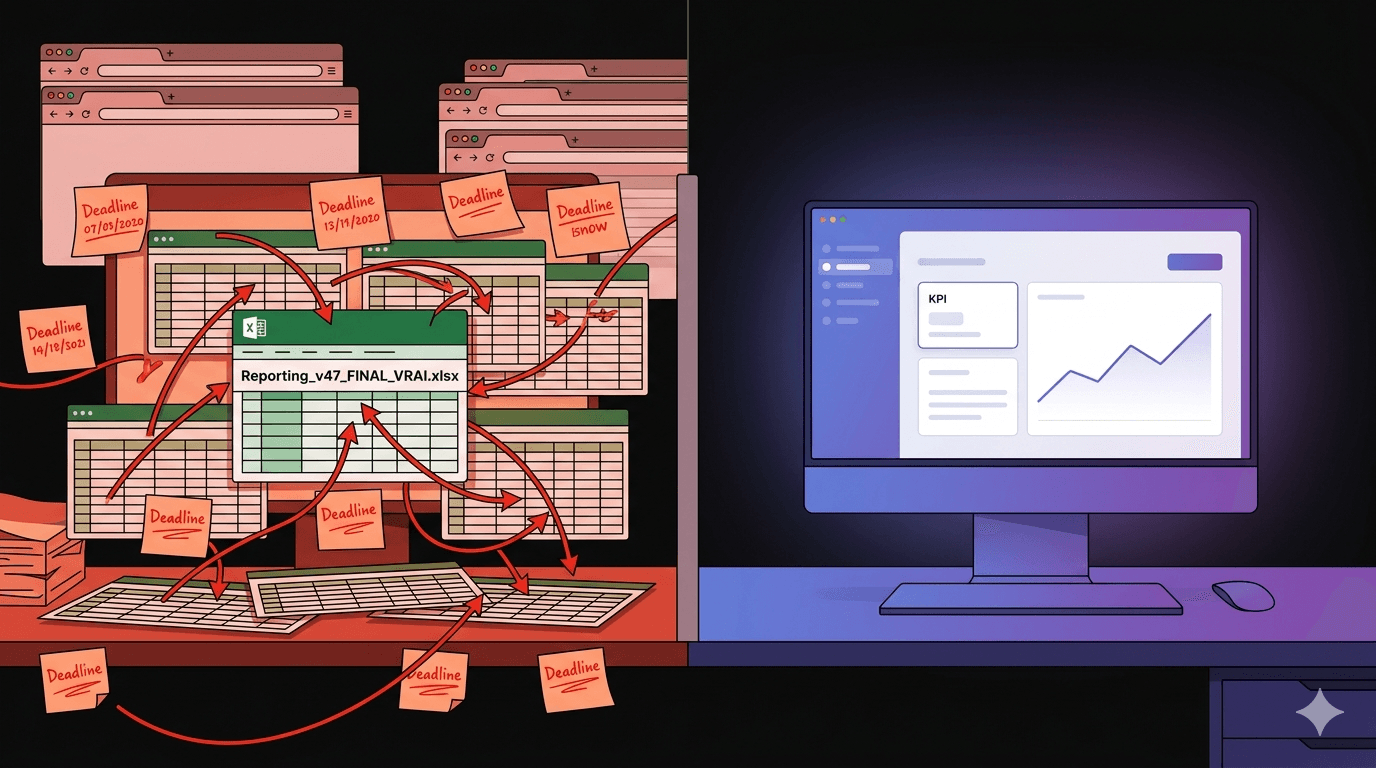
It's 6pm. Your CFO asks for revenue by customer segment for Tuesday's exec committee. Your team opens an Excel file named Reporting_v47_FINAL_TRUE.xlsx. It's Friday evening.
You've missed something.
You don't have a data problem
You have a problem of decisions made blind.
Nobody hires a data consultant because they love pivot tables. You hire one because at some point, you can't decide anymore. Which customer segment actually pays off. Which product costs more than it earns. Why sales reps close fewer deals in May. Data is the tool. The decision is the real question.
Before looking for a consultant, ask yourself one thing: which strategic decision have you been putting off for the past 3 months because the numbers are fuzzy?
If the answer comes within 5 seconds, keep reading.
The 5 signs that don't lie
1. Excel has become your ERP by default
You have a CRM, maybe an ERP. But to actually run the business, everything converges into Excel files that two people know how to read. When one of them is on leave, decisions stop.
That's the first sign your tooling no longer matches your size.
2. Your team spends more than 30% of their time producing reports
Copy-paste from CRM export into Excel. Formulas rebuilt every month. Charts updated by hand. If your sales manager or project lead spends half a day per week manufacturing numbers instead of analyzing them, you're paying twice: their salary, and the decisions they're not making during that time.
3. Your business tools don't talk to each other
CRM, ERP, billing, website, email marketing, inventory. Each lives in its own silo. Every business question that crosses two tools becomes a project. "What's our conversion rate from website to signed deals?" turns into "we'll get back to you in 2 days."
If your tools don't exchange data, your teams are doing it manually on their behalf.
4. You can't answer a business question in 5 minutes
Concrete test: take a simple question your CEO might ask in a meeting. "Who's our best customer over the past 6 months?" or "What does product X actually cost us, all-in?" If the answer requires more than 5 minutes, a call to 3 people, or a CSV export, you have a visibility problem, not an information problem.
The information is there. It's just not available when you need to decide.
5. You want to "do AI" but your data is dirty
AI comes up in every exec committee. You've watched two webinars. You've tested ChatGPT. But your customer data sits in four systems, poorly cleaned, with duplicates. Putting an AI model on that foundation is building a ten-story tower on ground you never checked.
AI doesn't compensate for a lack of data structure. It amplifies it.
Data consultant, data analyst, IT lead: who does what
The three roles often get confused. They solve different problems.
The external data consultant works on strategy. They audit what exists, identify the real levers, and propose a plan tailored to your size and maturity. Their mission has a start and an end. Their deliverable is an actionable roadmap, not an 80-page report that ends up in a drawer.
The in-house data analyst runs the infrastructure once it exists. They produce recurring dashboards, analyze operational data, answer business questions. It's a permanent role, useful once the machine is running.
The IT lead or CIO handles the technical plumbing. They select and maintain tools, manage integrations, secure data flows. Essential, but not their job to define data strategy.
Order matters. A data consultant clarifies what you actually need. An analyst then takes over on clean foundations. Not the other way around.
For more on this kind of engagement, see the data consulting page.
When NOT to hire a data consultant
If you have fewer than 10 employees, no structured CRM, and no written sales process: it's too early. A data consultant doesn't invent your processes. They can only optimize what already exists.
If your need is "a Looker Studio dashboard to track sales," you're not looking for a consultant. You're looking for a day-rate freelance data analyst. That's 5 to 10 times cheaper, and exactly what you need.
If you already have an in-house data team running, a consultant steps in on a specific topic: AI, automation, architecture rework. Not to redo everything from scratch.
The worst data consultant is the one who takes the engagement you don't need.
The 3 questions to ask before signing
1. How will you audit during the first two weeks?
The good answer is concrete: interviews with three to five key people across business teams, mapping of data flows, prioritization of currently blocked decisions. The bad answer: "We'll start with a framing workshop." If nobody talks to the operators, nothing gets understood.
2. What deliverable do I get at the end of the audit phase?
The good answer: a prioritized roadmap with concrete milestones, effort estimates per track, and tailored to your company's size. The bad answer: "A strategic framing document." If you can't act after reading the deliverable, it's hot air.
3. How do my teams take over after you leave?
The good answer: explicit knowledge transfer, documentation your in-house teams can actually use, and a clear commitment that the engagement has an end. The bad answer: vague. A consultant who doesn't plan your autonomy has an interest in staying.
To wrap up
If three of the five signs resonate, you're ready to ask the question seriously.
Not to sign tomorrow. To have a straight conversation, 30 minutes, zero commitment, that tells you whether a data consultant would actually help. Or whether you need to invest somewhere else first.
Book a call. Or see directly what I offer as a mission.
Want to ship this in your company?
If you want to identify exactly where AI can move the needle in your business, scoped and mapped in a structured one-week engagement.