
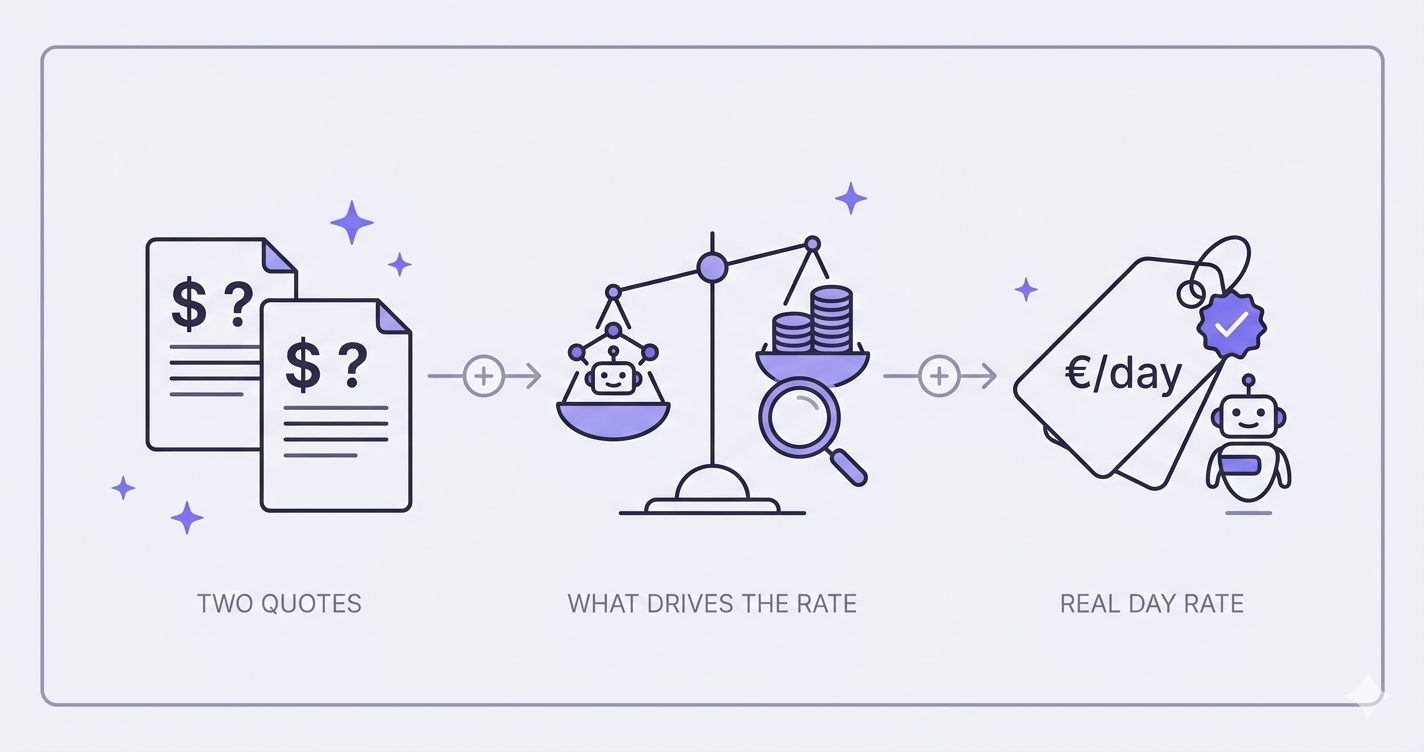
Since ChatGPT, everyone is an "AI consultant". The developer who wired up an API, the ex-project manager who watched two webinars, the firm that bolted "& AI" onto its homepage. Same title, same line on the invoice, and day rates running anywhere from $600 to $4,000.
If you're a buyer staring at two quotes, that gap is unreadable. It's not a scam. It's a pricing grid nobody explained to you. Here it is, market by market and engagement by engagement.
Why AI consultant rates range from $400 to $4,000+ a day
Four classic variables, plus one specific to AI, explain almost the entire spread.
Experience level. Someone who can call the OpenAI API and someone who has shipped a RAG system to production, handled hallucinations, cost-per-query and latency, are not selling the same product. Both will say "I do AI". Only one knows when not to.
Engagement type. A five-day POC and a production agent deployment with monitoring don't price the same way. The first is scoped and disposable. The second carries duration, risk and maintenance.
Provider form. A solo freelance, a small collective, an independent agency, and a Big4 firm sell the same hour at wildly different prices. Big4 senior AI day rates cross $4,000, not because the consultant is four times better, but because you pay for the brand and the overhead.
Geographic market. US rates run 2x to 2.5x Canadian for the same seniority, and Dublin runs lower than London despite both being EMEA hubs.
Skill scarcity. This is the AI-specific factor. LLM, computer vision and NLP specialists carry a premium that a generalist doesn't, because demand outruns supply and the EU AI Act has created a new compliance niche overnight.
AI consultant rates by market in 2026
United States
Per Second Talent's 2026 freelance AI developer survey and goLance's 2026 ML engineer hourly guide, cross-referenced with Nicola Lazzari's US AI consultant pricing analysis ($600-$1,200/day freelance, $1,500-$2,500/day agency):
- Junior (2-3 years): $400 to $720 per day, based on $50 to $90 per hour
- Mid (4-7 years): $720 to $1,040 per day, $90 to $130 per hour
- Senior (8+ years): $1,040 to $1,520 per day. Specialists in LLMs, MLOps or GenAI hit $150 to $300+ per hour, which translates to $4,000 days for the top tier
SF Bay Area, NYC and Seattle run 30 to 40% above middle America. True 1099 freelance is the minority: most "freelance" US AI consultants operate C2C through their own LLC, which moves the headline rate 30 to 40%.
United Kingdom
Per ITJobsWatch (six-month window ending June 2026):
- Junior (25th percentile): ~£450 to £520 per day
- Mid (median): Machine Learning Engineer £700, Machine Learning Scientist £548, broad ML roles £570
- Senior (75th to 90th percentile): £750 to £900+ per day
AI and ML contractors command a 60 to 80% premium over general software contractors (£350-£450/day). The UK runs a mature contractor market, mostly via limited companies operating outside IR35 when the engagement allows. London concentrates 60 to 70% of demand and runs 10 to 20% above the rest of the country.
Canada (English-speaking, Toronto and Vancouver)
Honest disclaimer: no public 2025-2026 source breaks down freelance AI day rates by seniority for Canada. The numbers below are an estimate, derived from Glassdoor contract rates and the Hays Canada 2026 Salary Guide, with the AI premium applied.
- Junior: ~CA$450 to CA$600 per day (estimate)
- Mid: ~CA$600 to CA$900 per day (estimate)
- Senior: ~CA$900 to CA$1,400 per day (estimate)
Toronto leads (banks, telco), Vancouver close behind. Montreal carries a strong AI ecosystem around MILA but sits on the French-speaking side of the market.
Australia
Morgan McKinley's 2026 Australia Technology Contract Salaries guide flags GenAI as one of the few specializations still getting premium increases. Built on their data scientist brackets plus the AI premium:
- Junior (2-3 years): AU$700 to AU$950 per day
- Mid: AU$950 to AU$1,250 per day
- Senior (8+ years): AU$1,250 to AU$1,700 per day, with GenAI and lead profiles capping the range
Sydney leads (big 4 banks, fintech, mining tech), Melbourne runs 5 to 8% behind. Australian rates typically include 11.5% mandatory superannuation, so net to consultant is lower than the headline suggests.
Ireland (Dublin)
Per Morgan McKinley's 2026 Ireland Technology Contract Salaries guide, contractors operate through their own limited companies. Built on the data scientist contract brackets plus the AI premium:
- Junior (2-3 years): €250 to €320 per day
- Mid (4-7 years): €320 to €420 per day
- Senior (8+ years): €450 to €700 per day for AI and ML specialists
Over 90% of demand sits in Dublin (EMEA HQs of Google, Meta, OpenAI, Stripe). Freelance day rates run lower than the headline perm equivalents because Irish contractors typically operate via limited company with tax optimization.
The right AI consultant isn't the one with the lowest day rate. It's the one whose POC actually ships to production and still runs six months later, without them.
Why the same consultant has three different prices (US)
US-specific, and it trips up almost every European buyer. The same person shows three rates depending on contract structure. W2 means hired as a temporary employee through a staffing agency, with payroll taxes withheld. 1099 means independent contractor invoicing you directly. C2C (corp-to-corp) means you contract through their LLC or S-Corp, the most common path for senior US AI consultants.
Same talent, same scope, the headline rate moves 30 to 40% across these structures based on who absorbs payroll taxes. On top of that, the AI specialty premium stacks: LLM development carries +30 to 50% over a generalist rate, computer vision and NLP +20 to 35%. A senior generalist at $130/hour and an LLM specialist at $250/hour can be the same number of years in.
Rates by engagement type
A POC or scoping engagement is usually fixed-price, 3 to 8 days. This is where the biggest trap in the AI market lives: the POC that dazzles in a demo and never reaches production. Demand a written production-readiness criterion at scoping, not a demo video.
A build (RAG system, agent, integration) is a scoped day rate. The seniority brackets apply directly. Check the production deliverable and the cost-per-query, not the number of days.
Team training is often a packaged rate per session. Useful, but watch the consultant whose only offer is training. Teaching AI without ever shipping to production is selling theory.
AI compliance (EU AI Act / GDPR) carries a premium day rate because the skill is scarce and the legal risk is real. Here the premium is justified by scarcity, not theater.
Strategic advisory carries a premium, often 20 to 40% above the technical grid, because you're paying for the consultant to say "this AI project shouldn't exist", not to ship it.
What justifies a high rate (and what doesn't)
AI multiplied the bluff. More than on any other market, the title "AI consultant" guarantees nothing. Three things justify a high rate, and only three.
Measurable ROI: concrete numbers from previous engagements, not testimonials. If the agent kills 200 hours of manual processing a year, $15k of consulting is a rational decision.
Vertical expertise: a consultant who knows the value chain of an insurer, a distributor or a manufacturer skips three weeks of context-building. The domain separates the prompt tinkerer from the consultant, and it's exactly what I break down in what I actually do.
The ability to say no: not executing a request, but saying "your real problem isn't AI, it's the upstream process", "this chatbot won't help anyone", "this use case can't tolerate hallucination". That's worth paying for because it avoids six-month AI projects that should never have started.
What doesn't justify it: the firm's brand, the polish of the slides, a "proprietary methodology" that turns out to be a four-step checklist, and above all the consultant reselling ChatGPT prompts at the price of a real integration.
How an SMB should arbitrate
Three rules before signing anything significant.
Pay for a 1-2 day test deliverable before committing to the full engagement. A real consultant accepts this on a small but representative use case. A fraud refuses on principle. It tells you in 48 hours what three reference calls won't.
Demand a written production-readiness criterion. On AI more than anywhere, "we'll do a POC and see" is the origin of half the projects that derail. Written scope, production deliverable, acceptance criteria, estimated cost-per-query. A POC with no production condition is a decorative POC.
Verify real availability. A senior at $1,000 a day available two days a week ships in four months what a mid-level full-time wraps in six weeks. Compute total cost and timeline, not the headline day rate.
The day rate is one number in an equation. The right equation is useful deliverable divided by total cost and timeline. If you want to know which bracket you sit in and what a real AI quote should contain for your case, let's talk for 30 minutes.