
"AI Consultant" can mean anything. On LinkedIn, it's the default title for anyone who's opened ChatGPT more than three times. In consulting firms, it's a junior with an 80-slide deck on "digital transformation through artificial intelligence".
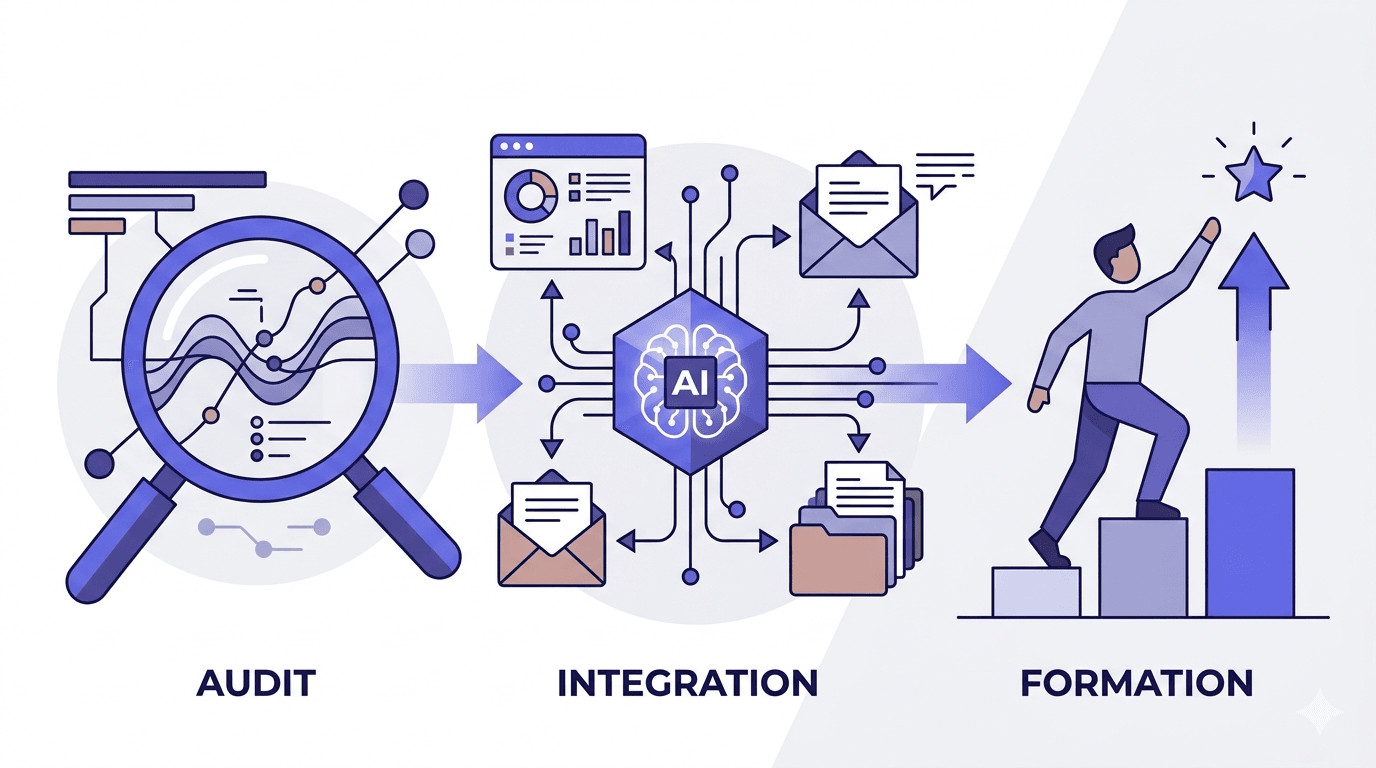
I code, I integrate, and I train. Here's what that actually looks like.
What a freelance AI consultant is NOT
Let's start with what I don't do.
I'm not a data scientist. I don't build machine learning models from scratch. If you need someone to train a neural network on your proprietary data, I'm not your guy.
I'm also not the person who shows up with a presentation on "the top 10 AI use cases in 2026". You've seen that content twenty times already. It hasn't helped you move forward.
What I do is bridge the gap between AI technology that exists today (LLMs, APIs, RAG, automation) and your business processes running in production. The bridge between "we could use AI" and "AI is running, the team uses it, we're measuring the gains".
What I actually do
Audit: understand before proposing
First thing when a company reaches out: I don't talk about AI. I talk about their day-to-day.
What tools do your teams use? Where do they lose time? Which processes are repetitive, predictable, time-consuming? What data exists, in what format, where?
That's where I identify the spots where an LLM can actually make a difference. Sometimes the answer is an internal chatbot connected to your documentation. Sometimes it's a 50-line Python script. Sometimes it's: "you don't need AI, you need a clean spreadsheet."
I'd rather lose a deal than sell a project that won't deliver.
Integration: connecting AI to real workflows
The audit identifies the "what". Integration is the "how".
Concretely, it looks like this: a RAG system that lets your teams query internal documentation in plain language instead of digging through 200 files. An n8n workflow that automates incoming email processing and routes them to the right department with a summary. A Claude or OpenAI API connected to your CRM to generate personalized client responses.
At Google (via Teleperformance), I automated reporting pipelines that took 10 hours per week to produce manually. AI is useful when it's plugged into a real process, not when it runs in a demo.
AI impresses nobody in a PowerPoint. It becomes useful when it's plugged into your team's daily workflow.
Training: making your teams autonomous
A tool nobody uses correctly is a dead tool. I've seen companies pay for licenses for months on tools that three people used, badly.
I train your team on the practical stuff: how to write prompts that give usable results, how to spot when AI hallucinates, what data to never send to an external tool, how to adapt the tool to their actual workflow.
The goal is simple: they shouldn't need me after the engagement.
Why freelance (and not a consulting firm)
When you work with a firm, you talk to the salesperson during the pitch. Then a project manager takes over. Then a junior consultant does the work. Three people, none of whom master both the technical and business sides.
With me, it's the same person from the first call to the last deliverable. I run the audit, I code the integration, I train the teams. One point of contact who understands your context because he's seen it from the inside.
Another difference: I don't bill to fill a schedule. If your project takes three days, it takes three days. Not three weeks to justify a package.
Who this is for
Let's be clear about who I can help, and who I can't.
This is for you if:
- You're an SME that wants to go from AI curiosity to something concrete
- You have usable data (even basic: CRM, tickets, knowledge base)
- Someone internally owns the topic and can make decisions
- You want first results in weeks, not months
This is NOT for you if:
- You need someone to train a custom model on your proprietary data
- You want to "do AI" without a concrete problem to solve
- You need a ten-person team on an 18-month transformation project
If you're not sure which category you fall into, that's exactly the kind of thing we can figure out in thirty minutes. I have an AI readiness assessment grid that helps clarify things.
Next steps
Full details on my method, tech stack, and pricing are on my AI consulting page, including for companies based around Annecy or Haute-Savoie.
And if you simply want a 30-minute chat to see if AI makes sense for your business, the contact form is right below. No slides, no pitch. Just an honest conversation.