
Tuesday, 10am, exec meeting. Someone says "we need a data person." The CFO pictures a specialist who'll finally deliver clean monthly reports. The COO imagines someone who'll connect the CRM to the ERP. The CEO thinks about a strategy, AI, a roadmap for 2027.
Three people. Three different jobs. Same job title.
The real choice isn't "which one". It's "what phase you're in"
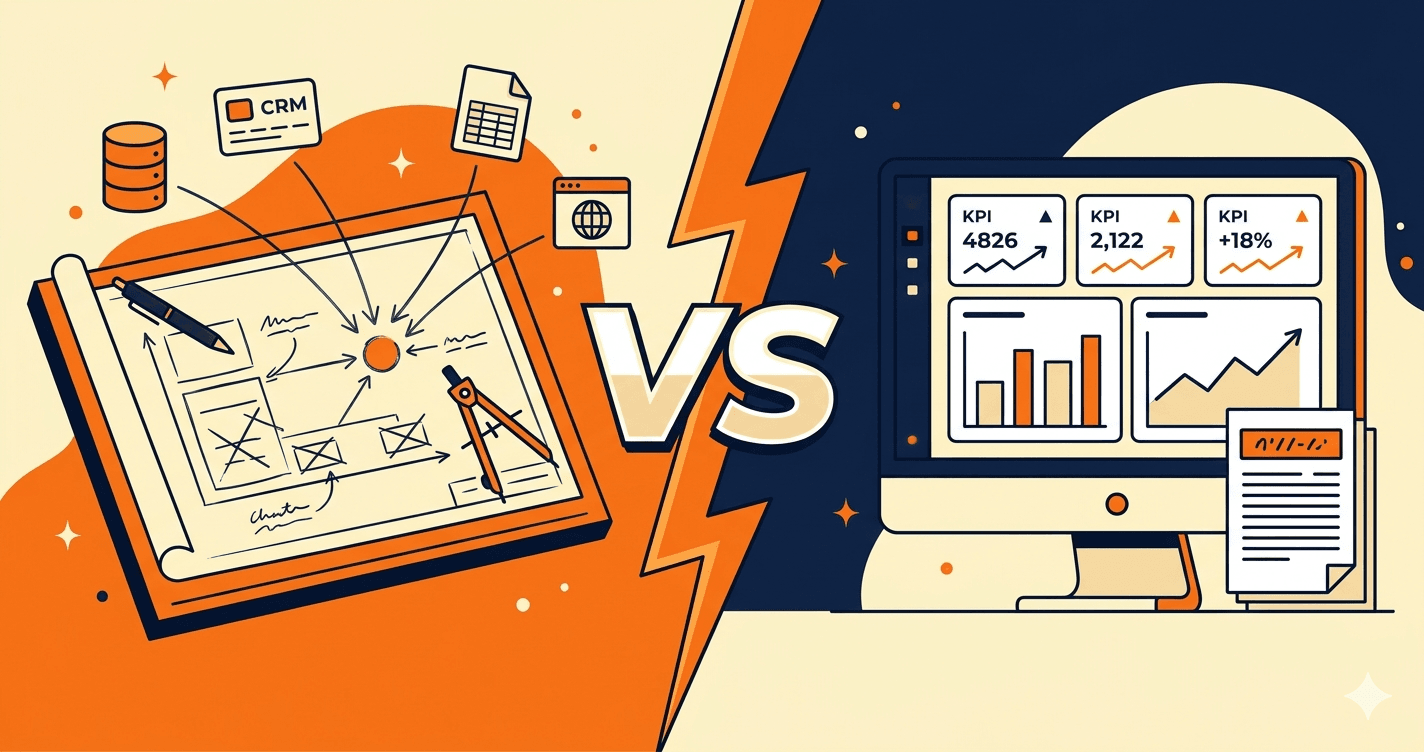
A data consultant and a data analyst don't sit in the same seat. They come in on either side of an invisible line: does the data structure already exist?
If yes, you need someone to operate it. That's the analyst.
If no, you need someone to build it. That's the consultant.
Most companies burn six to twelve months figuring this out, because they hire the wrong profile first. They get a brilliant analyst who ends up doing architecture work they weren't hired to do, gets frustrated, leaves after nine months. Or they get a consultant for a need that was just "build me a sales dashboard."
Getting this right the first time saves a full year.
What a data analyst actually produces
An analyst plugs into infrastructure that exists. The CRM is in place. The ERP is in place. The warehouse works. Maybe there's a BI tool already deployed. Their job starts there.
Typical deliverables:
- Recurring dashboards (monthly revenue, sales pipeline, retention cohorts)
- KPI tracking against targets
- Ad-hoc analyses when the business asks a specific question
- Data cleaning inside the existing setup
An analyst is a permanent seat. You hire them full-time, they ramp up over three months, and they produce value for years. Their output is operational: the machine runs, they make it visible.
If you already know what questions to ask every month and the data is clean enough to answer them, you want an analyst. Check the freelance data analyst page if you need one on a day-rate basis before committing to a hire.
What a data consultant actually produces
A consultant comes in before the machine exists, or when it's been running on duct tape for too long.
Typical deliverables:
- Audit of the existing setup (tools, data sources, gaps)
- Tool selection (warehouse, BI, ETL, reverse ETL, whatever is missing)
- Architecture decisions (how sources feed the warehouse, who owns what)
- A roadmap with priorities, effort estimates, and budget
- Transfer to the in-house team that will operate it after
The engagement is bounded. It has a start, a middle, an end. Three weeks, three months, six months depending on scope. When it's done, you have a structure you can operate, and someone else (the analyst) takes over. For the detail on where to start a data audit, that's where this really begins.
Hiring the consultant before the analyst is not a luxury move. It's a sequencing decision.
The consultant builds the house. The analyst lives in it.
If you're not sure which phase you're in, the earlier article how to know if your company needs a data consultant walks through five concrete signs.
The comparison that helps you decide
| Axis | Data analyst | Data consultant | |---|---|---| | Typical deliverable | Dashboards, KPI reports, ad-hoc analyses | Audit, tool selection, architecture, roadmap | | Engagement length | Permanent (in-house) | 3 weeks to 6 months, bounded | | Typical cost | $75-100k gross annual salary | $900-1400/day for a senior profile | | What breaks if you pick wrong | Analyst stuck doing architecture they weren't trained for, burns out, leaves | Consultant delivers a strategy nobody operates | | When you call them | When the machine runs and you need numbers out of it | Before the machine exists, or when it's breaking down |
This isn't a skills matrix. It's a decision matrix. The question is never "who is more senior" or "who knows more SQL." The question is: is your structure ready to be operated, or does it still need to be built?
Three signs you want an analyst
Your tools are already in place and talking to each other. Salesforce, HubSpot, NetSuite, whatever. The data lands where it's supposed to land. You just don't have anyone making sense of it daily.
You ask the same questions every month. Revenue by segment, churn rate, pipeline health, rep performance. Recurring, predictable, with a clear definition of each metric. That's analyst work, every single month.
You need produced numbers on a daily cadence. The sales leader wants the pipeline updated every morning. The CFO wants weekly cash forecasts. Someone has to run those queries and keep them fresh. That's not consultant work. That's operational analyst work.
Three signs you want a consultant
Your data is scattered across four or more tools with no single source of truth. CRM says one revenue number, billing says another, the CEO's Excel says a third. Nobody agrees. Before anyone can analyze anything, someone has to decide which source wins.
You have no clear tool stack yet, or you're outgrowing the one you have. You're on spreadsheets and want to move to a real warehouse. Or you're on a BI tool that doesn't scale past the three dashboards you have. You need someone to choose the next stack and plan the migration.
You need direction before you can hire. You know you need "a data person" but you can't write the job description. That's the clearest signal: a consultant comes in, scopes what you actually need, then you hire the right analyst with a brief that makes sense.
The adjacent-title trap
While we're clarifying roles, let me close the door on the other confusions that cost companies months.
A data engineer builds the pipelines that move data between systems. They write the code that pulls data from Salesforce into your warehouse every hour. You need one when your data volume or complexity is too high for off-the-shelf connectors. Different job from both analyst and consultant.
A data scientist builds predictive models. Churn prediction, demand forecasting, recommendation engines. If your question doesn't involve predicting something or finding patterns in unstructured data, you probably don't need one yet.
A BI analyst is usually a synonym for data analyst, sometimes with a stronger focus on dashboard tools (Tableau, Power BI, Looker). Same role, slightly different flavor depending on the company.
If someone on your team is pitching you a "data scientist hire" and you don't have clean dashboards yet, stop. That's three steps ahead of where you are.
Budget: salaried analyst vs consultant over 12 months
Let's run the numbers because this is where decisions get made.
A salaried data analyst in the US costs you $75 to $100k gross annual for a mid-level profile (loaded with employer burden around 25-30%, you're looking at $95 to $125k/year). That's a permanent commitment. You'll spend three months ramping them up before they produce real value.
A senior freelance data consultant runs around $900 to $1400/day. For a three-month structuring mission, count $60 to $90k, bounded.
Useful heuristic: the salaried analyst becomes cheaper than the consultant around 8 to 10 months of continuous activity. It's not a precise calculation (a consultant doesn't bill 20 days per month, there's prospecting, deliverables, admin), more an order of magnitude that shows where the real-life breakpoint sits.
But here's the trap: if you don't have the structure to operate, hiring the analyst first means paying them $100k/year to do architecture work they're not trained for. They'll spend their first nine months choosing tools and wiring sources instead of producing insights. You're paying analyst rates for consultant output. And you'll end up hiring a consultant anyway, six months late.
Sequence matters more than cost.
The question that settles it
When you're interviewing candidates, ask one question and listen carefully:
"If I hire you Monday, what are you doing Tuesday morning?"
If the answer is "I open your dashboards and start looking at the data," you're talking to an analyst. Perfect fit if your structure is ready.
If the answer is "I take two days to understand the existing setup, map your sources, and interview three to five people across sales, finance, and ops before recommending anything," you're talking to a consultant. Perfect fit if your structure isn't ready.
If the answer is vague or sounds like a framework deck, neither. Keep looking.
This is the same question I ask in scoping calls. Settles in five minutes what would have taken a recruiter three weeks.
To wrap up
If you're still hesitating between the two, you almost certainly need the consultant first. Hesitation is the signal that your structure isn't clear yet, and an analyst can't fix that with dashboards.
Start with a structuring engagement, end with a roadmap that tells you exactly which analyst to hire and what brief to give them. Let's talk if you want a 30-minute call to figure out which phase you're actually in.