
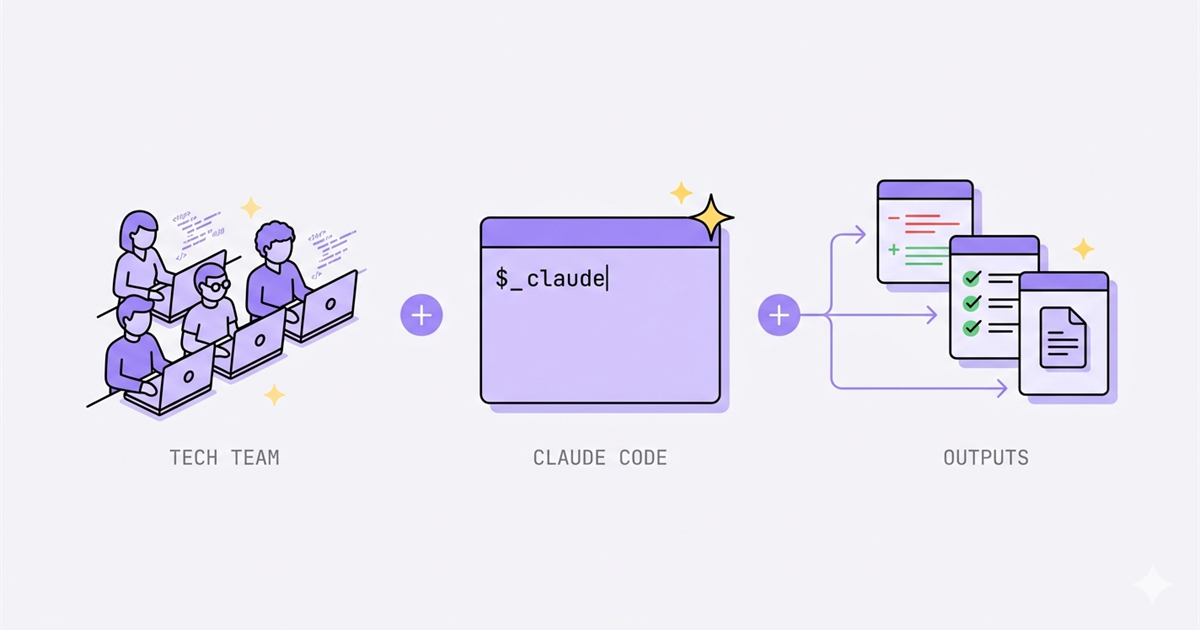
Monday morning. A lead dev installs Claude Code. First test: refactor a 400-line legacy module nobody wants to touch. Four minutes later, clean diff, tests pass, patterns match the rest of the repo. By lunch, his decision is made: tomorrow, the whole team gets onboarded.
Three weeks later, two devs have uninstalled it. One uses it to autocomplete one-liners and complains it's "just a slow Copilot". The lead wonders where the promised gain went.
Most common story I see in 2026. Not a tool problem, a workflow problem. Claude Code for teams isn't an IDE upgrade. It changes how the team writes code, reviews code, and decides what counts as "done". Installed without framing, it becomes either a toy or a risk.
What Claude Code actually changes (it's not Copilot)
Copilot and Cursor tab mode complete a line. They live inside your typing rhythm. Claude Code lives outside it. You give it a task, it reads the repo, edits 12 files, runs the tests, hands you a diff. You review, approve or send it back.
You stop writing assisted code and start describing tasks and reviewing results. Typing speed becomes irrelevant. Framing a task tightly and reading a diff carefully become the new core skills. Senior devs feel that shift immediately. Juniors often don't.
Claude Code doesn't make your devs faster at coding. It makes your slow-coding devs more strategic.
For teams running agentic systems internally, the line between Claude Code and a homegrown agent gets blurry fast. I covered build vs. off-the-shelf in the Agent SDK piece. SitePoint's 2026 comparison reports 46% of senior developers named Claude Code their "most loved" tool.
Real gains after 1 month of serious use
Faster onboarding on legacy codebases
New dev landing on a Next.js codebase, 80k lines, four years of history. Old playbook: two weeks reading code and bothering the senior dev. New playbook: two days. The new arrival asks the repo targeted questions and gets answers with file paths and snippets.
Anakeen, a French software vendor, published a December 2025 field report where R&D manager Charles Bonnissent describes a new hire refactoring a prototype in 2.5 weeks against an estimated 2-3 months without AI. incident.io documented the same pattern: CLAUDE.md treated as doc-as-code, custom slash commands for the workflows new joiners need most. The doc finally gets read because the agent reads it for them.
Refactor and code review before push
Before you push, you ask Claude Code to review your own diff. It catches obvious regressions, drifting types, patterns that don't match the rest of the repo. Not a PR review replacement, a first filter before another human sees it.
Dzianis Karviha's individual report shows the ceiling when one developer integrates it deeply: +63% net lines per week, +370% test lines per week, more atomic commits (50/wk vs 30). One person, one workflow, not a generalized study.
Tests and docs generated without friction
Coverage moves from 40% to 75% in two weeks because writing the test stopped being a chore. READMEs and CHANGELOGs stay current because updating them costs 30 seconds instead of 30 minutes.
Anthropic's "How AI Is Transforming Work at Anthropic" reports roughly 50% productivity gain across engineering, average task complexity moving from 3.2 to 3.8 / 5 in six months. The nuance matters more than the headline: more than half of respondents could only fully delegate 0-20% of their work. The leverage is real. The full automation fantasy isn't.
The pitfalls everyone hits
Delegating too fast, reviewing too fast
A dev approves a 600-line PR after a 30-second glance because "Claude generated it, it's probably fine". Four days later, a bug ships to prod. Rule: the bigger the diff, the longer the human review, not the other way around.
Vincent Quigley at Sanity captured the iteration reality in "First attempt will be 95% garbage": three attempts is the typical path. 95% garbage, then 50%, then something usable. Peter Harrison's "Pitfalls of Claude Code" lists three anti-patterns I see constantly: jumping into code without discussion, silent decision-making, and the one-shot mentality combined with the model's tendency to agree with you. The discussion phase before the code phase isn't optional.
Permissions too wide in local
--dangerously-skip-permissions running in someone's home directory, which one day executes a misaimed rm -rf. Not theoretical. Ends up on Twitter every few weeks. Solution: .claude/settings.json per project, versioned, tight allowlist, no global bypass.
Check Point Research published CVE-2025-59536 (CVSS 8.7) on remote code execution through pre-trust hooks. The CLI has the widest attack surface among Claude interfaces because it executes commands locally. Pull a repo with a hostile .claude/ directory and you can get owned. Security framing on day one, not month three.
Hallucinations on poorly documented internal APIs
The agent invents endpoints, parameters, and types when the repo lacks clear docs. Not lying, pattern-matching on what similar repos usually have. If your internal API breaks the pattern and nothing documents the break, you get hallucinations.
Solution: document the repo for the agent as much as for the humans. Side benefit: the docs finally stay current because they have a daily user. Anthropic's best-practices guide puts it bluntly: "give Claude a way to verify its work" is the single highest-leverage thing you can do. Keep CLAUDE.md short. Test: would removing this line cause Claude to make a mistake? If no, cut it.
The method we ended up adopting
Four pillars survived contact with reality.
One CLAUDE.md per repo, short and project-specific. Conventions, things not to do, the weird historical decisions the agent would otherwise repeat. Not a wiki dump.
Custom skills for repeated workflows. Release notes, security review, database migration. The workflows your team runs the same way every time become commands. The MCP layer plugs in here, which I unpacked in the MCP piece for tech decision-makers.
Pre/post-commit hooks that block, not warn. Type-check and tests are required. The agent generates code fast, which means it generates broken code fast.
Per-project permissions, versioned in .claude/settings.json. No loose global config. The Explore → Plan → Code → Commit workflow in Anthropic's best practices is the canonical structure. It works because it forces the discussion phase before the code phase.
Who Claude Code for teams actually helps, who it hurts
Claude Code for teams isn't a universal win. It helps teams of 3-15 devs on medium-to-large codebases, tech leads who want to industrialize good practices currently living only in senior devs' heads, and senior devs who want to delegate grunt work and focus on architecture.
It hurts juniors left on their own (they learn less because they copy without understanding), already ultra-clean codebases where the marginal gain is small, and companies that deploy it without a training budget. That last one is the most common failure mode.
A French SMB case study from Impli (Édouard Gonet, March 2026) reports a 3-dev team saving 36-48h per week against roughly 60€/month in licenses. Édouard is explicit about the limit: it works for technical profiles. The CLI is a barrier for non-engineers, so the gain stays inside the dev team.
Closing the loop
Claude Code is a multiplier, not a replacement. It multiplies what the team already knows how to do, good or bad. Clean team plus Claude Code ships faster. Sloppy team plus Claude Code ships chaos faster.
The tool changed completely. Five times. The discipline required to use it didn't change once.
That's Paddo's one-year retrospective talking, and it lines up with what I see. The tooling moves fast. The discipline is the constant.
If you want a hand integrating Claude Code into your team without losing your security model or your process, the Claude consulting page is the right starting point, or reach me via the contact form.
Want to ship this inside your team?
If you want Claude Code integrated into your team with proper security framing, clean permissions, and structured onboarding, delivered in 2-3 weeks.