
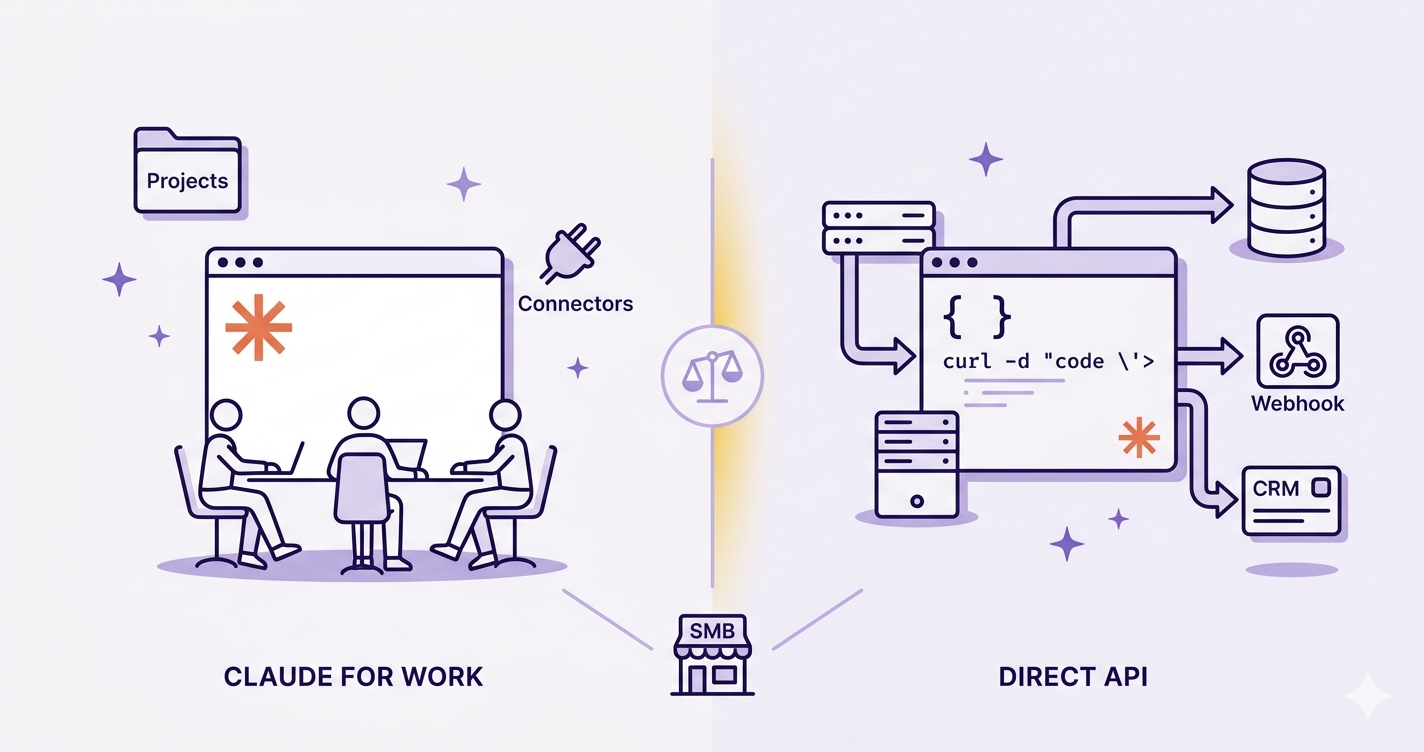
The false problem clients bring me in 2026: "Should we get Claude Team or pay per token?" The real problem, once we sit down: nobody in the company can describe where Claude needs to plug in, who uses it, and what gets done with the output. Without that, the pricing debate is theatre.
Here's the framing nobody hands you. Claude for Work (Pro, Team, Enterprise) is a productivity suite for humans clicking around. The Messages API is plumbing for code that runs without anyone watching. They solve different problems. The mistake is treating them as substitutes when they're complements.
Anthropic now ships Opus 4.7 and Sonnet 4.6 in production, with the Opus tier repriced to $5/$25 per million tokens since Opus 4.5 in late 2025, down from $15/$75 on Opus 4.1. Cowork went GA in April 2026. The pricing maths from twelve months ago is wrong now. So is the architecture advice.
What Claude for Work gives you without code
Claude for Work is the bundle name covering Pro ($20/mo individual), Team, and Enterprise. The Team plan starts at $25/seat/month for Standard, $125 for Premium, with SSO, JIT provisioning and SCIM available. Enterprise kicks in at 20 seats self-serve (50 for sales-assisted), with SSO + domain capture, RBAC, audit logs, Compliance API, Analytics API, and HIPAA-ready infrastructure.
What you get without code: Claude in a browser tab, Projects with shared context, connectors to Google Workspace, Notion, Slack, GitHub, and the connector directory at claude.ai/connectors that respects source-inherited permissions and never trains on connector data.
The piece that changed the calculus this year is Cowork, which went GA in April 2026, included on Pro, Team and Enterprise, with granular MCP controls and admin governance. Translation: Claude can now spend twenty minutes browsing your Drive, your Notion and your Jira to produce a deliverable without anyone babysitting it.
If your team's bottleneck is "we spend three hours a day rewriting the same kind of doc, summarising the same kind of meeting, drafting the same kind of email", Claude for Work solves it today, with admin controls your security team will tolerate.
What the direct API actually unlocks
The Messages API is stateless. You send the full conversation history on every call, you specify max_tokens, you handle retries. Pricing on the public Anthropic pricing page: Opus 4.7 at $5/$25, Sonnet 4.6 at $3/$15, Haiku 4.5 at $1/$5 per million tokens. Cache reads at 0.1x input price. Batch API at 50% discount.
This is what you reach for when the work happens without a human in the loop. A nightly job that scores 4,000 leads. A webhook that triages support tickets in 200ms. A pipeline that summarises 600 PDFs over the weekend.
The cost levers are stackable and rarely talked about together. Prompt caching drops cached input to 10% of normal cost. The Batches API adds a 50% discount for jobs under 24 hours, up to 10,000 requests per batch. Combine the two and you compress a workload to around 5% of the on-demand price. I broke down the caching numbers in this article on prompt caching at Anthropic.
The API is also where MCP lives in production. The protocol launched in late 2024 with Block, Apollo, Zed, Replit and Sourcegraph as initial adopters. If your workflow needs Claude to talk to ten internal services with custom auth and retry logic, that's API territory.
Claude for Work is a productivity tool. The API is infrastructure. Mixing them up is how you end up overpaying for one or underdelivering with the other.
The four-question decision framework
Before any pricing comparison, I run this with the client. Four questions, in order.
1. Who triggers the work, a human or a system? A human typing a prompt = Claude for Work. A cron, a webhook, a queue, a button inside your own product = API. If both, you need both. Don't force one stack to do both jobs.
2. Does the workflow need to ship inside your product, or stay internal? If end users of your SaaS hit Claude through your UI, you need the API. Claude for Work is for your employees, not your customers. The licensing model doesn't allow reselling seats.
3. What's the predictable volume per user per month? Heavy individual usage above roughly 50 to 100 long conversations per user per month tends to break even fast on Pro/Team. Below that, you're paying for capacity you don't use. Above that, you're getting a real subsidy compared to API rates on long contexts. Fazm.ai documented a real Max plan user burning roughly 10 billion tokens in 8 months, which would have cost around $15,000 on the API versus $800 paid.
4. Do you have compliance constraints? Regulated industries with HIPAA, healthcare, finance with audit log requirements: Enterprise plan, period. Anthropic's Salesforce partnership announced in October 2025 put Claude inside the Salesforce trust boundary, which means VPC isolation for regulated workloads. Anthropic also signed the EU Code of Practice in July 2025, which simplifies the compliance conversation for European clients.
Answer those four, and 80% of the decision is already made.
Cost comparison: two scenarios and a hybrid
Let me ground this with two concrete shapes I see often.
Scenario A: 30-person SMB, internal productivity tool. Marketing, sales and ops use Claude daily for drafting, summarising, research. No customer-facing feature. Volume per user: 30 to 80 conversations a month, mostly Sonnet-class work.
Team plan at $25/seat/month (annual) = $750/month for 30 seats. Connectors to Google Workspace and Notion included. Cowork now bundled. No engineering time required.
Same workload on the API at average 100K input + 5K output per conversation, 50 conversations per user, 30 users: roughly 150M input tokens + 7.5M output tokens per month on Sonnet 4.6 = $450 input + $112 output = $562 raw. Add prompt caching on shared context and you drop closer to $300. Cheaper, on paper.
But you also need: a custom UI, auth, history storage, an admin console, a billing layer, and an engineer on call when it breaks. Runbear's mid-market analysis puts the all-in cost of Enterprise plans somewhere between $20 and $60 per user per month depending on volume, which lines up with what I see. For 30 internal users with no product integration: pay the Team plan, move on.
Scenario B: SaaS startup with an AI feature for end users. A customer-facing assistant inside the product, 2,000 daily active users, average 8 turns per session, mix of Haiku for routing and Sonnet for substantive answers.
There is no scenario where Claude for Work is the right answer here. You need the API, you need streaming, you need usage-based billing on your own side. The numbers work out around $0.04 to $0.12 per active user per month with aggressive caching. Multiply by your DAU. That's your COGS line.
The hybrid case (most common in real life). Your 30 employees use Claude for Work for daily knowledge work. Your product uses the API for the customer-facing feature. Your finance team integrates a Claude-powered reconciliation job through the API on top, billed against the same Anthropic account. Three contracts, one vendor, three different rationales. This is the right shape for most SMBs scaling past 20 people.
GitLab is a public example of this hybrid. GitLab uses the Enterprise plan internally and the API inside the product, reporting 98% team satisfaction and 25 to 50% productivity gains on the internal side. Sourcegraph uses Claude for Work for community feedback analysis at 95% accuracy. Different jobs, different tools, same vendor.
The trap of defaulting
Two failure modes I see weekly.
Default to the API because "it's cheaper". You burn three months of engineering time building a chat UI with auth, history, admin, billing, audit, document upload, and connectors. By the time you ship, your team has been waiting for the tool they could have had in 48 hours. The "savings" are negative once you factor opportunity cost.
Default to Claude for Work because "no-code is faster". You buy 50 Enterprise seats so your product team can build a customer-facing feature on top. Six weeks in, you discover the licensing doesn't allow reselling seats, the connectors don't give you programmatic control, and you can't get per-customer usage analytics. You rebuild on the API anyway, having paid for seats you didn't use.
The signal you're defaulting: nobody on the team can articulate which question from the framework above pointed to the chosen option. If the decision came from "everyone else does it this way", you're defaulting.
This is the same trap I covered upstream when discussing model selection in Claude vs GPT for SMBs: the right answer always comes from your workflow, never from a generic comparison table.
What I recommend, concretely
For most SMBs in 2026, the right entry sequence is:
- Start with Claude for Work (Team plan), 5 to 10 power users, 30 days of real usage.
- Identify the two or three workflows where humans are now bottlenecked downstream of Claude (data flowing somewhere, decisions needing to be propagated).
- Build the API integration for those specific workflows. Stay narrow.
- Add seats on Claude for Work as adoption spreads, add API workloads as automation cases emerge.
That sequence is how you avoid both traps. You buy the productivity gain immediately on the human-typing side, and you reserve engineering time for the cases where the API actually pays back. The full integration pattern, including the part where Claude reads from Notion, posts to Slack, and writes to your CRM, is what I walked through in this method for integrating Claude into Notion, Slack, and CRM.
The decision isn't binary. It's sequential. And the sequence depends on which side of your business is hurting first.
If you want a second pair of eyes on which side that is for your case, that's exactly what I do. Book a free Claude consulting audit or tell me where it hurts in 30 minutes and we'll map the right shape together.
Sources
- Introducing Claude Opus 4.5 — Anthropic (November 24, 2025)
- What is the Team plan? — Anthropic Support (2026)
- Claude Enterprise plan — Anthropic (2026)
- What is the Enterprise plan? — Anthropic Support (2026)
- Use Google Workspace connectors — Anthropic Support (2026)
- Use connectors to extend Claude's capabilities — Anthropic Support (2026)
- Anthropic Takes Claude Cowork Out of Preview and Straight Into the Enterprise — The New Stack (April 2026)
- Claude Cowork — Anthropic (2026)
- Pricing — Anthropic API Documentation (2026)
- Messages API reference — Anthropic Documentation (2026)
- Introducing the Message Batches API — Anthropic (October 2024)
- Prompt caching — Anthropic API Documentation (2026)
- Introducing the Model Context Protocol — Anthropic (November 25, 2024)
- Salesforce and Anthropic Expand Strategic Partnership — Anthropic (October 14, 2025)
- Anthropic signs the EU Code of Practice — Anthropic (July 21, 2025)
- GitLab Enterprise customer story — Anthropic (2026)
- Sourcegraph Claude for Work customer story — Anthropic (2026)
- Claude Pro vs API Cost Comparison — fazm.ai (2025)
- Claude Enterprise Pricing for Mid-Market — Runbear (2025)